
Bring Back the Deer Dog
Why Maryland should rethink a century-old ban
6/14/20266 min read
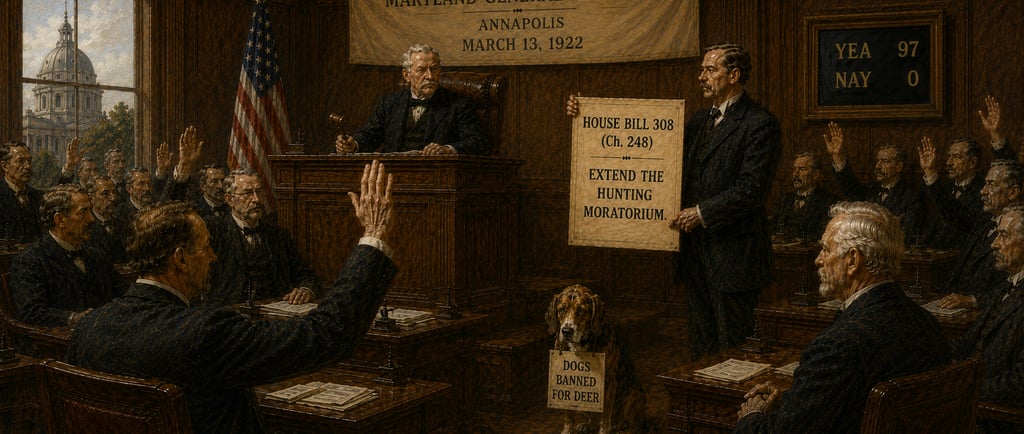
When I moved from Germany to the United States, the part of hunting culture I missed most was hunting with dogs.
I grew up around driven hunts for deer and wild boar and later participated in them after becoming a hunter myself. I listened to hounds work through thick cover and push game into the open. A successful hunt was rarely the work of a hunter alone. It was a partnership between hunter and dog.
Blood tracking was not considered optional. If an animal was wounded, recovering it with a trained dog was simply what responsible hunters did. The skill of a good tracking dog still impresses me more than almost anything else in hunting.
Bird dogs never really clicked for me. Hounds and blood trackers did. Running one of those dogs had always been a dream of mine.
So when I arrived in Maryland, I was surprised by what I found. Blood tracking was still relatively unknown. In many states it was prohibited entirely. Even where it was legal, dogs often had to remain on a leash. That made little sense to me.
A leashed tracking dog can lead you to a dead deer. But when a tracker realizes the wounded deer is still alive and moving ahead of the dog, the leash quickly becomes a limitation. In most cases, the only responsible option is to stop the track, back out, and return later in the hope that the animal has bedded down or expired. The very tool designed to reduce suffering becomes less effective when it is needed most. I was even more surprised to learn that hunting deer with dogs had been outlawed across most of the Northeast.
In Germany there is an old saying: It's no hunt without a hound. To understand why Maryland sees things differently, you have to go back a century.
A law written for a different Maryland
In the early 1900s, deer populations across much of the Northeast were collapsing. Wild game was routinely sold in restaurants and butcher shops, and professional market hunters supplied that demand. The federal Lacey Act of 1900 helped bring that system to an end by restricting interstate commerce in illegally taken wildlife and laying the foundation for modern wildlife conservation.
Maryland closed deer hunting in 1902 as populations collapsed. By 1922, the use of dogs for deer hunting was prohibited, and in 1937 the General Assembly authorized the killing of dogs found chasing deer. These laws were written during a conservation emergency, when protecting every remaining deer was the priority.
The emergency ended. Through decades of restoration efforts, including the relocation of more than 2,000 deer across the state, Maryland rebuilt its herd. What followed became one of the state's great conservation success stories. Today the problem is no longer too few deer. It is too many.
The deer problem we have today
Maryland's deer population now sits around 200,000-250,000 animals despite annual harvests of 70,000-80,000 deer.
Hunters are not the only ones removing deer. Another ~10,000 are removed through crop damage permits, ~30,000-35,000 die in vehicle collisions, and thousands more are taken by government sharpshooters in suburban parks and watersheds. Altogether, more than 100,000 deer are removed annually, not including losses to disease, yet the population remains remarkably stable.
The costs are significant. Deer-vehicle collisions are estimated to cause more than $200 million in damages each year in Maryland. Crop damage is estimated at roughly $60 million annually. Forest regeneration suffers in many parts of the state as deer browse heavily on young trees and native vegetation. The challenge facing Maryland wildlife managers today is not protecting deer. It is managing them.
From market hunting to wildlife management
The concerns that shaped Maryland's deer-dog laws reflected a world that no longer exists. Today, deer are not being overharvested by market hunters with packs of hounds. They are managed by licensed hunters under tightly regulated seasons.
Ironically, something valuable disappeared as well. In Germany, hunters can sell venison through local markets, restaurants, and game dealers. Many people who never hunt still eat venison and appreciate the role hunters play in providing it. In the United States, that connection largely vanished with the end of market hunting. While the conservation reasons for restricting commercial sale of wild game remain sound, most non-hunters rarely encounter venison at all.
As society becomes increasingly urban, that matters. People tend to support what they understand and value. When non-hunters can experience wild game as food, they gain a tangible connection to hunting and wildlife management. When that connection is absent, hunting is more easily viewed as recreation alone rather than as a source of food, conservation funding, and public benefit.
Looking across the Atlantic
As someone who grew up hunting in Germany, I find another contrast particularly interesting. Germany is often viewed as a highly regulated country, yet hunting with dogs faces surprisingly few statutory restrictions. Germany is much larger than Maryland, but the two have nearly identical population densities. If high human population density were fundamentally incompatible with hunting dogs, Germany should be one of the first places to prohibit them.
Instead, hunting with dogs is considered a normal part of wildlife management. What makes this even more surprising is how Germany regulates the practice. Rather than prescribing every detail in law, the government largely relies on hunting organizations to establish testing standards and certify dogs. Blood tracking, driven hunts, and other forms of dog work are governed less by statute and more by performance standards developed by the hunting community. In many ways, that approach feels more American than German.
We already have the foundations for such a system here and standards already exist. Organizations such as United Blood Trackers and the American Blood Trackers Association have spent years developing testing programs and best practices. Retriever clubs, beagle clubs, and hound organizations do the same for other hunting disciplines. The real issue is whether Maryland is willing to recognize those standards and move beyond restrictions written during a conservation crisis a century ago.
A better way to manage deer
The fact that Maryland still experiences 30,000-35,000 deer-vehicle collisions annually despite substantial hunting pressure and additional removal programs should tell us something important: the state does not have a deer shortage. The challenge is not finding ways to protect deer. The challenge is finding effective and publicly acceptable ways to manage them.
A deer harvested by a hunter provides food, recreation, and conservation funding. A deer killed by a vehicle becomes an insurance claim. A deer removed by a taxpayer-funded sharpshooter becomes a budget item.
If Maryland needs to reduce deer numbers, shouldn't we prefer the solution that turns a management problem into a public resource? Every deer harvested through regulated hunting is one less deer available to damage crops, browse forests, or potentially collide with a vehicle.
Bringing hunters back into the woods
Hunter recruitment is already a major concern in Maryland. The state's hunting population has been declining by roughly 13 percent per decade despite significant recruitment efforts. Not every person is drawn to the same style of hunting. Some enjoy sitting in a tree stand. Others are drawn to waterfowl, small game, or hunting with dogs.
Driven hunts are highly social. Young hunters can participate before they are ready to hunt independently. Families and friends work together. For many people, especially younger hunters, that experience can be a more engaging introduction to hunting than sitting alone in a stand.
Maryland does not need fewer hunting opportunities. It needs more ways for people to become involved.
What about the concerns?
Critics raise legitimate concerns. Dogs can cross property lines. Deer can be pushed toward roads. Poorly managed drives can encourage rushed shots. Those concerns deserve attention. They are also solvable.
Many European countries and several American states have decades of experience regulating deer hunting with dogs. GPS collars, handler certification, seasonal restrictions, designated hunting areas, recall standards, and limits on dog types all help address these issues.
For recovery work, certified tracking dogs can locate wounded deer that would otherwise be lost. In states that allow off-lead tracking, dogs can bay a wounded deer, allowing a quick and humane dispatch.
As someone who tracks wounded deer, this is the point that matters most to me. Every hunter eventually makes a less-than-perfect shot. When that happens, our responsibility begins. We owe that animal every reasonable effort to recover it and end its suffering as quickly as possible. A trained tracking dog is one of the best tools developed for that purpose.
A hundred-year-old answer to a problem we no longer have
Maryland's deer-dog ban was good policy in 1922. Deer were scarce. Market hunting was rampant. The herd needed protection.
It is 2026. Deer are one of the most abundant large mammals in the state. They shape forests, damage crops, collide with vehicles, and challenge wildlife managers across Maryland. At the same time, hunter numbers continue to decline. Deer no longer need the kind of protection that justified these laws a century ago. What wildlife managers need today is access to every responsible and effective management tool available.
Bringing back the deer dog is not about nostalgia. It is not about copying Germany or the South. It is about recognizing that laws written for a conservation emergency a century ago may no longer fit the reality on the ground.
The dog at a hunter's feet is not new technology. It is the oldest tool in the kit. And after more than a hundred years, it may be time to let Maryland use it again.
Connect with us
Contact
Germantown, Maryland
info@koldnose.com
+1-202-751-8912
© 2025. All rights reserved.
The content and forms contained on koldnose.com are not to be considered as legal advice. All content is for informational purposes, and Kold Nose Tracking makes no claim as to accuracy, legality, or suitability. The site owner shall not be held liable for any errors, omissions, or damages of any kind.